New Lot Restock — Fall batch now in stock · Shipping worldwide ·

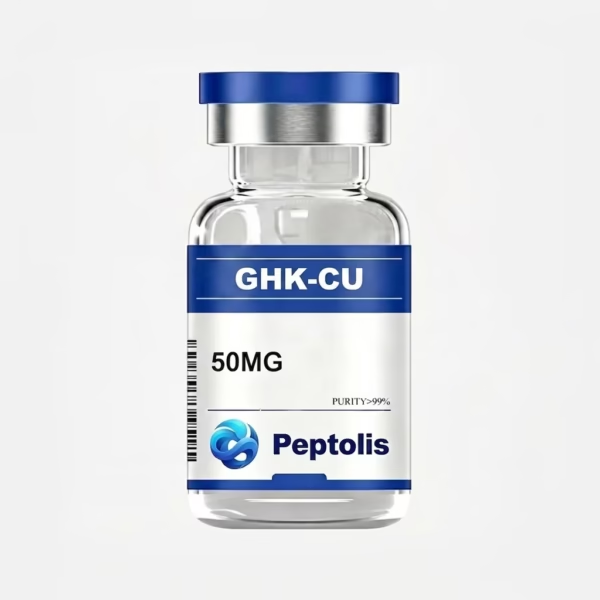
GHK-CU
Price range: $23.00 through $45.00
GHK-Cu is a copper-bound tripeptide consisting of three amino acids — glycyl-L-histidyl-L-lysine (Gly-His-Lys, GHK) — complexed with a divalent copper ion (Cu2+).
What is GHK-Cu?
GHK-Cu is a copper-bound tripeptide consisting of three amino acids — glycyl-L-histidyl-L-lysine (Gly-His-Lys, GHK) — complexed with a divalent copper ion (Cu2+). The tripeptide GHK itself is found endogenously in mammalian blood plasma at picomolar concentrations and declines with age in published serum studies. The copper-bound form (GHK-Cu) is the bioactive complex used in research applications. Molecular formula C14H24CuN6O4, molecular weight 404.92 g/mol.
Research Context
GHK-Cu is studied extensively in the preclinical research literature for its interactions with copper-binding proteins, redox biology, and gene-expression modulation assays. Published research models include cultured fibroblast lines, keratinocyte models, and a range of in-vitro tissue research preparations. The compound’s distinctive copper chelation chemistry places it in its own structural class — most research peptides are pure-protein structures, whereas GHK-Cu is a metallopeptide whose copper coordination is central to its activity.
Mechanism of Action (Research Framing)
Published research characterizes GHK-Cu as a high-affinity copper carrier and modulator of copper-dependent enzyme systems. Mechanistic studies investigate its influence on:
- Lysyl oxidase activity — a copper-dependent enzyme central to extracellular matrix cross-linking research
- Antioxidant enzyme expression — research literature documents effects on superoxide dismutase (SOD) family enzymes and other redox regulators in cultured cells
- Transcriptomic modulation — a 2010 transcriptomic analysis catalogued effects on over 4,000 human genes in cultured fibroblast preparations, making GHK-Cu one of the most extensively-profiled peptides in research-grade transcriptomics literature. Subsequent meta-analyses have replicated subsets of the gene-expression pattern in independent fibroblast and keratinocyte preparations
- Copper-dependent signaling — broader research into copper-binding protein interactions, including investigations of metallothionein response in treated cell cultures
The copper coordination geometry is critical to the compound’s behavior. GHK without copper has different binding kinetics and gene-expression signatures than GHK-Cu; researchers selecting between forms should consult their target literature carefully. The compound’s deep-blue color is a direct visual indicator of intact copper coordination.
Standard Research Assays
Published GHK-Cu research commonly employs:
- RNA-seq and microarray transcriptomic profiling in cultured human fibroblasts (the classic 4,000-gene dataset originated this way)
- qPCR analysis of specific gene transcript expression following GHK-Cu exposure
- ELISA quantification of extracellular matrix protein expression (collagen types I and III)
- Spectrophotometric measurement of copper coordination state via absorbance shifts
- Cell-culture growth and migration assays in fibroblast and keratinocyte models
- Western blot analysis of metallothionein and SOD enzyme expression
- Lysyl oxidase enzymatic activity assays in extracellular matrix research
- Inductively coupled plasma mass spectrometry (ICP-MS) for cellular copper content measurement
- Electron paramagnetic resonance (EPR) spectroscopy for copper coordination state analysis
- Live-cell imaging with copper-responsive fluorescent probes
- Collagen synthesis assays via hydroxyproline quantification in fibroblast cultures
- Mitochondrial copper-pool measurement in isolated organelle preparations
- Confocal microscopy of copper distribution in subcellular compartments
- Quantitative proteomics for copper-binding protein interactome analysis
Researchers working with metallopeptide compounds should also characterize their buffer system for trace copper contamination, which can confound the interpretation of copper-coordination-dependent effects in cell culture experiments. Standard glassware and serum-containing media typically introduce sufficient background copper to perturb low-concentration GHK-Cu assays, and chelator-purified buffers are commonly used in mechanistic research applications.
Storage & Handling
- Store sealed, dry, and protected from light.
- Long-term storage: -20°C recommended.
- Short-term storage: 2-8°C acceptable.
- Reconstitution: Use sterile technique with bacteriostatic water.
- Post-reconstitution: Stable up to 30 days at 2-8°C.
All handling instructions are intended for laboratory use only.
Related products
-
PT-141
$47.00 Select options This product has multiple variants. The options may be chosen on the product page
Reviews
There are no reviews yet.