New Lot Restock — Fall batch now in stock · Shipping worldwide ·

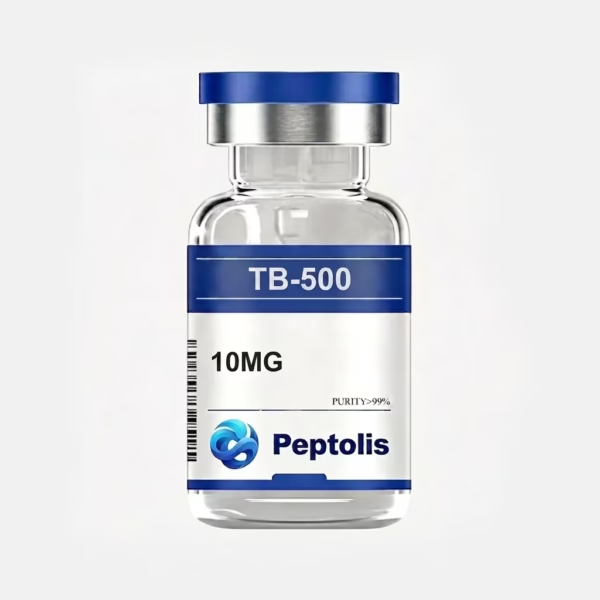
TB500 (Thymosin B4 Acetate)
Price range: $18.00 through $106.00
TB-500 is a synthetic peptide fragment derived from Thymosin Beta-4 (gene symbol TMSB4X), a 43-amino-acid protein found endogenously in nearly all human and mammalian cells.
What is TB-500?
TB-500 is a synthetic peptide fragment derived from Thymosin Beta-4 (gene symbol TMSB4X), a 43-amino-acid protein found endogenously in nearly all human and mammalian cells. The TB-500 fragment corresponds to the active region of Thymosin Beta-4 that mediates its primary biochemical function: binding to monomeric G-actin. Molecular formula C212H350N56O78S, molecular weight approximately 4,963 g/mol.
Research Context
TB-500 is studied across the preclinical literature in cytoskeletal research, with particular focus on actin-binding kinetics and cellular migration assays. Standard research models include cultured endothelial cells, fibroblast cell lines, and in-vitro wound-closure assay systems. The compound’s high water solubility makes it well-suited to standard aqueous buffer systems used in cell-culture protocols, and its larger molecular size relative to BPC-157 places it in a different physicochemical category for purification and storage methodology.
Mechanism of Action (Research Framing)
The published primary mechanism of TB-500 centers on its high-affinity binding to monomeric G-actin via a specific actin-binding motif preserved within the fragment sequence. By sequestering G-actin from the cellular monomer pool, the peptide modulates the dynamic equilibrium between G-actin (monomer) and F-actin (polymer) — the central machinery of cell motility, cytoskeletal remodeling, and intracellular cargo transport.
Specific molecular interactions documented in the published literature include:
- Actin sequestration — the canonical primary mechanism; the fragment binds one G-actin monomer per peptide molecule with submicromolar affinity in published binding studies
- Integrin signaling — secondary literature investigates TB-500’s modulation of cell-surface integrin engagement and downstream focal adhesion kinase pathway research
- VEGF expression — published work in cultured endothelial models examines TB-500 effects on vascular endothelial growth factor transcription
- MAPK cascade activation — downstream signaling research in cultured cell preparations
The peptide is also used as a research probe for actin-dependent cellular processes in mechanistic studies where actin dynamics are the experimental endpoint.
Standard Research Assays
Published TB-500 research commonly employs the following methodologies:
- F-actin polymerization assays measuring fluorescence kinetics of labeled actin
- Scratch-wound migration assays in cultured endothelial or fibroblast monolayers
- Transwell migration and invasion assays
- Immunofluorescence staining for actin cytoskeleton organization (phalloidin labeling)
- Live-cell imaging of migration kinetics in time-lapse microscopy
- qPCR and Western blot analysis of integrin and VEGF expression in treated cultures
- Capillary tube formation assays in Matrigel for angiogenesis research
- Co-immunoprecipitation studies of actin-binding partner proteins
- Surface plasmon resonance for direct measurement of G-actin binding kinetics
- Confocal microscopy of cytoskeletal reorganization in live cells
- Atomic force microscopy of cytoskeletal mechanical properties
- Mass spectrometry-based proteomics for actin-interactome characterization following exposure
- High-content imaging screens with automated quantification of cellular migration phenotype across multi-well plate formats
The compound’s actin-binding affinity is well-characterized; researchers replicating published binding kinetics should verify their stock solution concentration via absorbance at 215 nm or quantitative HPLC before assay setup.
Why Purity Matters for Research Validity
For a 43-residue-class peptide fragment like TB-500, common synthesis byproducts include truncated sequences (chains missing one or more amino acids at the N- or C-terminus), deletion mutants, and oxidation variants — particularly at methionine residues. A 95% pure TB-500 sample may contain enough truncated fragment to skew actin-binding kinetics measurements by 10–15%, which is precisely the effect size most published binding assays are designed to detect. The difference between research-grade and laboratory-grade purity is therefore not academic; it determines whether your data is signal or artifact.
All handling instructions are intended for laboratory use only.
Related products
-
Thymosin Alpha-1
Price range: $74.00 through $120.00 Select options This product has multiple variants. The options may be chosen on the product page -
BPC-157
Price range: $18.00 through $57.00 Select options This product has multiple variants. The options may be chosen on the product page
Reviews
There are no reviews yet.