New Lot Restock — Fall batch now in stock · Shipping worldwide ·

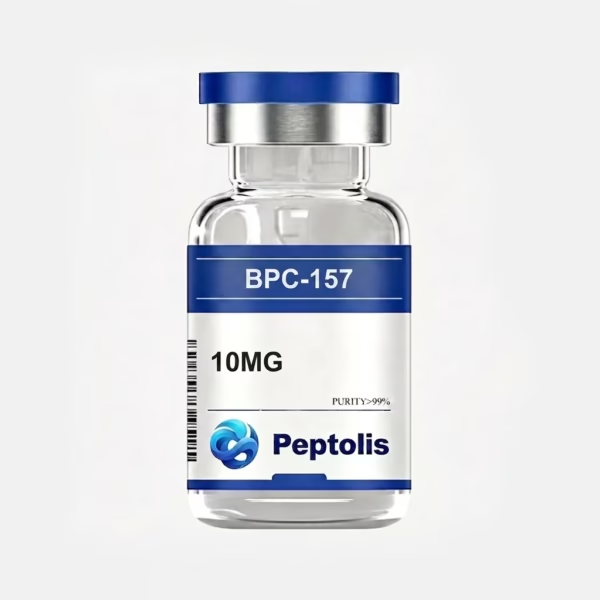
BPC-157
Price range: $18.00 through $57.00
BPC-157 — also written as BPC 157 or Body Protection Compound-157 — is a synthetic pentadecapeptide, a chain of 15 amino acids with sequence Gly-Glu-Pro-Pro-Pro-Gly-Lys-Pro-Ala-Asp-Asp-Ala-Gly-Leu-Val.
What is BPC-157?
BPC-157 — also written as BPC 157 or Body Protection Compound-157 — is a synthetic pentadecapeptide, a chain of 15 amino acids with sequence Gly-Glu-Pro-Pro-Pro-Gly-Lys-Pro-Ala-Asp-Asp-Ala-Gly-Leu-Val. The peptide corresponds to a partial sequence derived from a larger protein originally characterized in mammalian gastric juice. Its molecular formula is C62H98N16O22 with a molecular weight of 1,419.53 g/mol. CAS number 137525-51-0. Research Context
BPC-157 is studied across the preclinical research literature in models of connective tissue science, including tendon, ligament, and gastrointestinal mucosa investigations. Standard research models include rodent in-vivo preparations and a range of cultured cell lines used for migration, adhesion, and wound-closure assays. The compound’s published profile of stability in acidic environments — it survives gastric juice intact, a property that destroys most peptide structures — has also made it a reference compound in peptide stability research.
Mechanism of Action (Research Framing)
Published preclinical literature investigates BPC-157’s interactions with several signaling pathways relevant to tissue research. Among the most-studied:
- Vascular growth factor signaling — modulation of VEGF and FGF expression in cultured endothelial and fibroblast preparations
- Nitric oxide pathway — interaction with the NO/eNOS system, studied in vascular research models
- Neurotransmitter system research — published work on dopaminergic and serotonergic pathways in rodent in-vivo preparations, generally as exploratory mechanistic studies
- Gut-brain axis research — preliminary literature on enteric nervous system interactions, characterized as exploratory and not established
The compound’s signature property in the literature — its remarkable stability in gastric juice — has driven its adoption as a benchmark peptide in studies of peptide chemistry and oral bioavailability research. Researchers selecting BPC-157 for in-vitro work should consult the published methodology in their target literature directly.
Standard Research Assays
Published research using BPC-157 commonly employs the following in-vitro and ex-vivo methodologies:
- Scratch-wound migration assays in cultured fibroblast or endothelial monolayers
- ELISA panels measuring VEGF, FGF, and related growth factor expression in culture supernatants
- Western blot analysis of downstream signaling cascade activation (MAPK, PI3K/Akt)
- Histological evaluation of tendon and ligament tissue from rodent in-vivo preparations
- qPCR analysis of growth factor and extracellular matrix gene expression
- Hydroxyproline content quantification in collagen-research preparations
- Transmission electron microscopy of treated tissue ultrastructure
- Flow cytometry analysis of cell viability and proliferation markers
- Immunohistochemistry for tissue-resident cell-type identification post-experiment
- Tensile-strength biomechanical testing in ex-vivo tendon and ligament research preparations
Researchers integrating BPC-157 into novel assay systems should validate purity and concentration in their own buffer system before drawing conclusions.
Why Purity Matters for Research Validity
Research-grade BPC-157 must be high-purity to produce reproducible experimental data. Sub-threshold purity introduces synthesis-byproduct peptides (truncated chains, deletion sequences) and free amino acids that compete in binding assays, distort concentration-response measurements, and contaminate downstream proteomics analysis. A 95% pure sample is not 4% “almost as good” as 99% pure — the 5% impurity actively changes the chemistry of every assay well, every cell culture, and every measurement it touches.
Storage & Handling
- Store sealed, dry, and protected from light.
- Long-term storage: -20°C recommended.
- Short-term storage: 2-8°C acceptable.
- Reconstitution: Use sterile technique with bacteriostatic water.
- Post-reconstitution: Stable up to 30 days at 2-8°C.
All handling instructions are intended for laboratory use only.
Related products
-
Thymosin Alpha-1
Price range: $74.00 through $120.00 Select options This product has multiple variants. The options may be chosen on the product page -
TB500 (Thymosin B4 Acetate)
Price range: $18.00 through $106.00 Select options This product has multiple variants. The options may be chosen on the product page
Reviews
There are no reviews yet.