New Lot Restock — Fall batch now in stock · Shipping worldwide ·

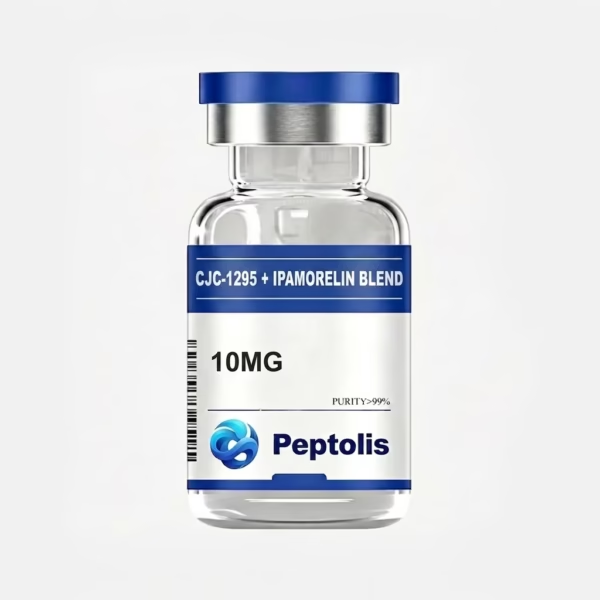
CJC-1295 + Ipamorelin Blend
Price range: $112.00 through $182.00
CJC-1295 + Ipamorelin Blend is a pre-formulated two-peptide research mixture combining a synthetic growth-hormone-releasing-hormone (GHRH) analog (CJC-1295) with a synthetic growth-hormone-releasing-peptide (GHRP) class compound (Ipamorelin).
What is the CJC-1295 + Ipamorelin Blend?
CJC-1295 + Ipamorelin Blend is a pre-formulated two-peptide research mixture combining a synthetic growth-hormone-releasing-hormone (GHRH) analog (CJC-1295) with a synthetic growth-hormone-releasing-peptide (GHRP) class compound (Ipamorelin). The blend is a research category known as a GH secretagogue combination — two compounds acting at different receptors on the same pituitary endocrine pathway. Both components are supplied together as a single lyophilized white powder in sealed vials for in-vitro laboratory research only.
Research Context
GH secretagogue research is studied extensively in the preclinical literature in models of pituitary endocrinology, growth-factor signaling, and somatotrope cell biology. Standard research models include cultured pituitary cells, primary somatotrope preparations, and in-vivo rodent models with serum hormone measurement endpoints. The blend format reflects a common research-methodology pattern in which both GHRH-receptor and ghrelin-receptor signaling pathways are studied in combination.
Mechanism of Action (Research Framing)
The blend studies two parallel signaling axes on the same somatotrope cell population:
- CJC-1295 — a synthetic GHRH analog with prolonged binding to the GHRH receptor (GHRHR) on pituitary somatotrope cells. The non-DAC variant (as in this blend) has an extended half-life relative to native GHRH but shorter than CJC-1295 with the Drug Affinity Complex (DAC) modification
- Ipamorelin — a synthetic compound studied as an agonist of the growth hormone secretagogue receptor (GHS-R1a, the ghrelin receptor) — a distinct receptor on the same somatotrope cell population, downstream of different intracellular signaling cascades than GHRHR
Published research investigates the combinatorial effect of dual-receptor agonism on somatotrope GH-release kinetics in cultured cell models and in-vivo rodent preparations. The two-receptor approach is studied because GHRH and GHS-R1a signaling activate complementary but distinct intracellular pathways — GHRHR primarily through Gs/cAMP/PKA, GHS-R1a primarily through Gq/PLC/IP3/Ca²⁺ — making the dual-agonist approach a useful research tool for studying somatotrope cell biology comprehensively.
The “blend” terminology reflects standard research methodology, not formulation chemistry — both compounds are pre-mixed at a fixed ratio for convenience in research protocols that study dual-receptor activation simultaneously.
Standard Research Assays
Published GH secretagogue research commonly employs:
- Cultured pituitary somatotrope cell preparations with GH release measurement (ELISA in culture supernatant)
- cAMP accumulation assays measuring GHRHR-axis activation
- Intracellular calcium flux measurements (Fura-2 or similar) for GHS-R1a activation
- qPCR analysis of GHRHR and GHS-R1a expression in treated cultures
- Western blot for downstream signaling (PKA substrates, PLCγ phosphorylation)
- Rodent in-vivo preparations with serum GH and IGF-1 measurement by ELISA
- Receptor binding affinity studies with radiolabeled ligand displacement
- Time-resolved fluorescence resonance energy transfer (TR-FRET) for receptor-G-protein coupling analysis
- Phosphoproteomics of somatotrope signaling cascades following dual-agonist exposure
- Single-cell RNA-seq of pituitary cell populations following GH secretagogue exposure
- Whole-pituitary in-situ hybridization studies of receptor expression patterns
- Patch-clamp electrophysiology of somatotrope cell-membrane responses
The kinetic profile of GH release in response to dual-receptor stimulation differs from single-receptor stimulation in published in-vivo research — the combinatorial signal exhibits both a faster initial release component and a prolonged release phase, attributed to the different intracellular signaling timescales of the GHRHR (Gs-coupled, cAMP/PKA) and GHS-R1a (Gq-coupled, calcium-mediated) receptors. Researchers designing comparative studies between single agonists and the blend should account for this temporal difference.
Storage & Handling
- Store sealed, dry, and protected from light.
- Long-term storage: -20°C recommended.
- Short-term storage: 2-8°C acceptable.
- Reconstitution: Use sterile technique with bacteriostatic water.
- Post-reconstitution: Stable up to 30 days at 2-8°C.
All handling instructions are intended for laboratory use only.
Related products
-
CJC-1295 with DAC
Price range: $31.00 through $112.00 Select options This product has multiple variants. The options may be chosen on the product page -
Sermorelin
Price range: $59.00 through $220.00 Select options This product has multiple variants. The options may be chosen on the product page -
CJC-1295 without DAC
Price range: $31.00 through $112.00 Select options This product has multiple variants. The options may be chosen on the product page -
Ipamorelin
Price range: $13.00 through $58.00 Select options This product has multiple variants. The options may be chosen on the product page
Reviews
There are no reviews yet.